FIRE SAFETY (ENGLAND) REGULATIONS 2022
Fire doors only work if the door, the frame and the wall around them all perform together. We check all three, and explain clearly what needs attention.
ESI: Fire Safety carries out fire door assessments, surveys and routine inspections for businesses, landlords and managing agents. We do not supply or fit fire doors, so our findings are never shaped by a sale.
GET A QUOTE
Send us the basics. We will review the project stage, likely scope and next step.
Professional memberships, registrations and industry credentials






The basics
A fire door is not just a heavy door. It is a tested, certified assembly, made up of the door leaf, the frame, the seals, the hinges and the closing device, all designed to work together to hold back fire and smoke for a specific period of time, usually 30 or 60 minutes.
If any part of that assembly is wrong, damaged, or has been altered, such as a hole drilled for a cable, a missing intumescent seal, or a self-closer that has been disconnected, the whole door can lose its rating even if it still looks fine from a distance.
This is why fire doors need checking by someone who knows what they are actually looking for, not just whether the door closes.
Talk Through Your Doors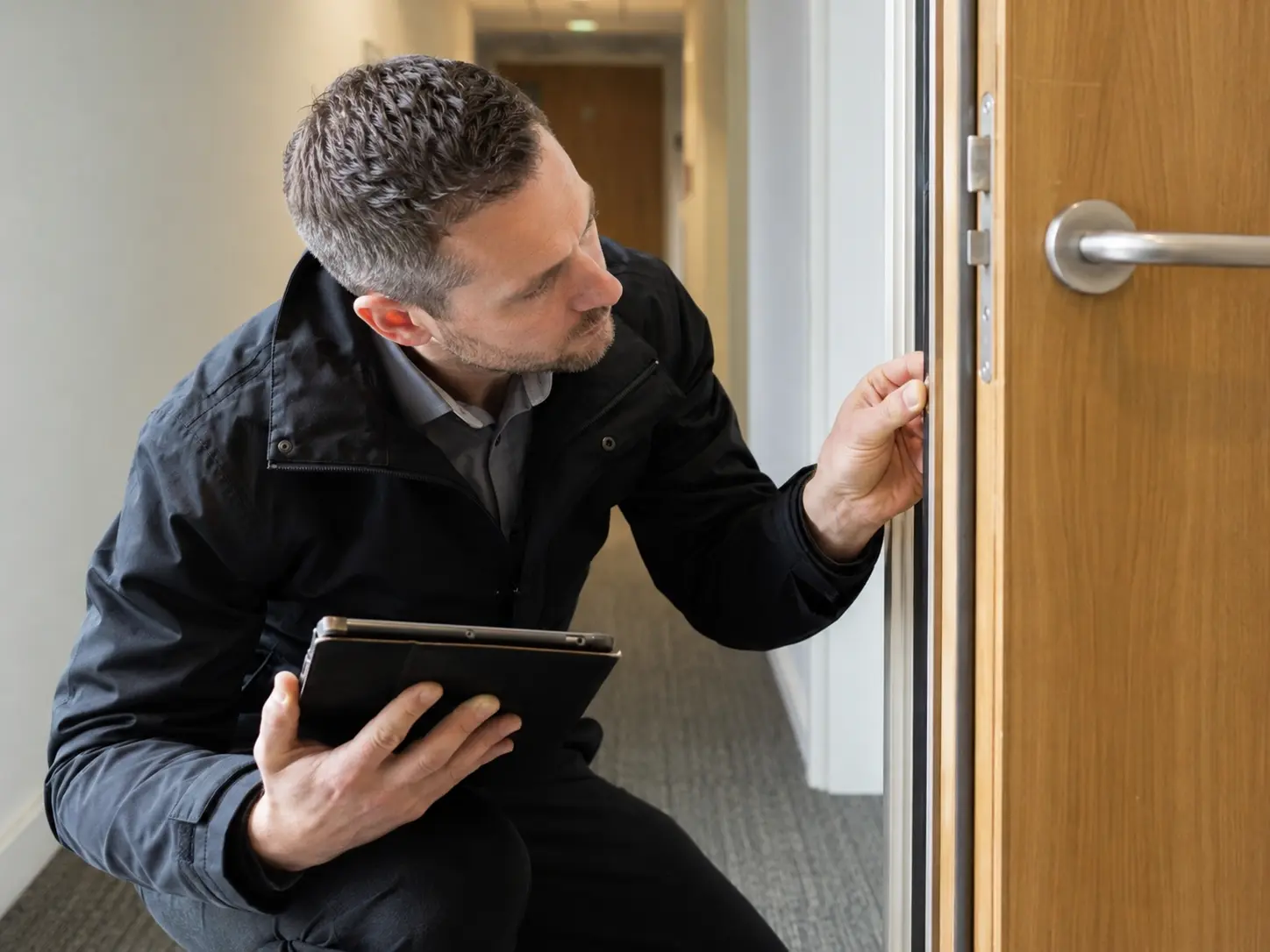
Assessor examining the seals, frame and condition of a fire door assembly.
WHICH SERVICE DO YOU NEED?
These three terms get used interchangeably, but they are different services, suited to different situations.
Not sure which one you need?
Tell us about your building and we will advise.
THE BIGGER PICTURE
A fire door only works as part of a wider system. Compartmentation is how a building is divided into fire resisting cells, using walls, floors and doors together, so that a fire stays contained long enough for people to escape and the fire service to respond.
Fire stopping is what makes that system actually work in practice. Every time a pipe, cable or duct passes through a fire resisting wall or floor, that gap has to be sealed to maintain the wall's rating. An unsealed service penetration can undo the protection of an otherwise good wall, even if the fire door sitting in it is perfect.
This is why a fire door survey in isolation can miss the real problem. We look at the door, the frame, and the wall around it together, because a good door in a compromised wall is not actually providing the protection it appears to.
One of the most commonly missed areas is above suspended ceilings. A compartment wall has to carry on through the ceiling void to the structure above, not stop at ceiling height, and it is easy for this to be overlooked during building works or later alterations. Our assessments always check above suspended ceilings for exactly this reason, and may also involve removing architraves to check installation standards and fire stopping behind the frame itself.
A quick check of certification labels tells you very little on its own. Our approach is a holistic review of the door and the compartmentation around it, not a box-ticking exercise built around certification stickers or a target for how much replacement work we can recommend.
Ask About Your Building's Compartmentation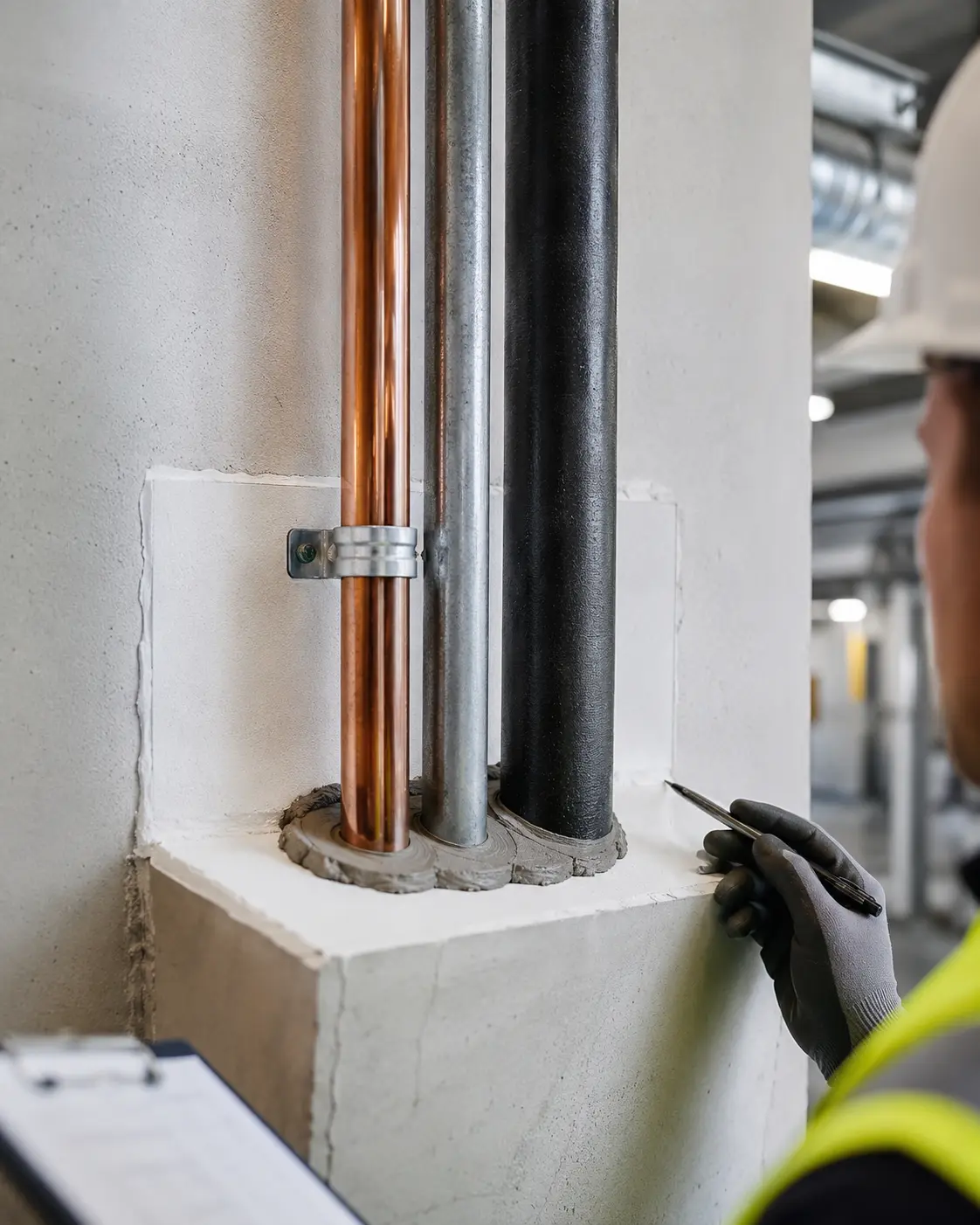
Checking service penetrations through a fire-resisting wall
Who it applies to
If your building has fire doors, which almost all non-domestic buildings and multi-occupied residential buildings do, you have a duty to keep them in good working order. For residential buildings over 11 metres, the Fire Safety (England) Regulations 2022 go further, requiring quarterly checks of communal fire doors and annual best-endeavours checks of flat entrance doors.
Not sure what your building needs?
Tell us a little about the premises and we’ll help you understand the right next step.
WHO IS RESPONSIBLE
This is the Responsible Person, whether that is an employer, a building owner, a landlord or a managing agent. For residential buildings, this is often a managing agent acting on the freeholder's behalf, coordinating access to individual flat entrance doors as well as communal areas.
Bringing us in to inspect, survey or assess your doors does not transfer that legal responsibility. We give you clear findings and a prioritised way forward, but acting on them remains with you as the Responsible Person.
Check who's responsible on your siteRTM & MANAGEMENT COMPANIES
If your building is managed by a Right to Manage company, or a residents' management company, the fire safety duty usually sits with volunteer directors, most of whom have no professional property or fire safety background. That is a genuinely difficult position to be in, particularly if you have recently taken over management from a freeholder or previous agent and are not confident in what you have inherited.
We can review whatever records exist, tell you honestly where the gaps are, and set out a clear, affordable way forward that your board can put to leaseholders with confidence. Where handover from a previous freeholder or agent has left records incomplete, we can also help establish an asset register from scratch, so you are not starting every renewal or insurance conversation from zero.
Get support for your RTM companySCOPE OF WORK
Exactly what we cover depends on the level of service, but a thorough check typically includes the following.
Door leaf
Condition, damage, and whether it matches its certification
Frame
Fit, condition and compatibility with the door
Gaps and seals
Intumescent and smoke seals, and gaps around the edge
Hinges and ironmongery
Correctly rated and in good condition
Self-closing device
Whether the door closes fully from any position
Glazing
Correctly rated fire-resisting glass, properly fitted
Signage
Fire door signage present where required
Certification labels
Whether the door's certification can still be verified
Surrounding wall
Condition of the compartment wall the door sits within
Installation standards behind the frame
Optionally intrusive, removing architraves to check fixing and fire stopping
Above suspended ceilings
Checking compartmentation continues through ceiling voids, not just at door height
The process
We keep the process clear and practical, from agreeing the right level of check through to a prioritised report and support with what happens next.
01
We agree which level of service suits your building and needs.
02
We look at any plans, previous surveys or certification records.
03
We examine each door in the agreed scope in person.
04
We weigh up what we found against what is required.
05
Findings written up clearly, prioritised against your fire strategy.
06
We talk you through the report and what to do next.
Ready to get started?
Get a quote in a couple of minutes, no obligation.
The deliverable
At the end of the process, you will get a clearly structured written report that includes:
A door-by-door asset register
Existing doors that are already satisfactory
Photographs of each door
Deficiencies we have identified
Certification details, where identifiable
A prioritised action plan
A description of each door and its location
Practical, proportionate recommendations
Findings against the relevant standard
Information on when to review or re-check
For assessments and surveys, this becomes a live asset register you can build on over time, rather than a one-off document that goes out of date the moment something changes.
See what's included
Fire door inspection report
Illustrative preview showing how findings can be structured and prioritised.
Example door record
Prioritised recommendations

Reviewing an existing fire door survey
INDEPENDENT REVIEW
We are often asked to review a fire door survey or assessment that someone else produced, whether that is to check it is thorough and accurate, or to make sense of a report that raised more questions than it answered.
Because we do not supply or fit fire doors ourselves, our review is genuinely independent. We are not incentivised to find extra work, and we will tell you plainly if an existing survey is sound rather than second-guessing it for the sake of it.
Get a Survey ReviewedPRIORITISING WORKS
Not every deficiency carries the same weight. A missing seal on a door protecting a single storeroom is a different priority to a self-closer that has failed on a door protecting the main escape route. Where a fire strategy exists for the building, we use it to understand how each door fits into the wider fire safety design, so our recommendations are prioritised against what actually matters for that building, not a one-size-fits-all list.
If you do not currently have a fire strategy, or are not sure whether the one you have is up to date, our Fire Strategies service can help establish that wider picture alongside your fire door work.
Ask About Prioritising Your WorksWHAT TO LOOK OUT FOR
These are some of the issues we see most often. None of them are usually obvious at a glance, which is exactly why a proper check matters.
COMMON
Intumescent and smoke seals expand in heat to block gaps. Missing or painted-over seals cannot do this.
COMMON
A door that does not close completely from any position is not protecting the escape route.
COMMON
Gaps beyond tolerance let smoke and fire past the door before the seals can act.
SERIOUS
Holes drilled for cables or fittings can break a door's fire rating entirely.
COMMON
Vision panels fitted with standard glass instead of fire-resisting glass compromise the door.
COMMON
Without a visible or traceable label, a door's fire rating can be difficult to verify.
COMMON
Splits, dents or panels knocked through can all reduce a door's ability to hold back fire, even if it still closes normally.
SERIOUS
A fire door held open defeats the point of it entirely. This is one of the most common, and most serious, issues we find.
COMMON
Cables or conduit run through the frame, rather than around it, can break the frame's fire performance where it matters most.
SERIOUS
Gaps, unsealed penetrations or damage to the wall around a door can undo its protection, even if the door itself is fine.
Spotted something that looks like this?
Get it checked properly rather than guessing.

Founder & Principal Consultant
ABOUT ESI
We are a small, specialist, consultancy led team, overseen by Jamie Morgan, who is listed on the Institute of Fire Safety Managers National Fire Risk Assessors Register and holds Level 4 and Level 6 qualifications in fire risk assessment.
We do not supply or fit fire doors, and we never will. That keeps our findings independent: we have no reason to find more work than is actually needed, and every recommendation we make is about what your building genuinely requires.
We also look at fire doors as part of the wider building, not in isolation, drawing on the same expertise we bring to fire risk assessments and fire strategies. Our reports are not built around a sales target or a certification checklist. They are built around what will actually keep your building's compartmentation working as intended.
"We do not supply or fit fire doors. That keeps our findings independent."
NFRAR
Registered fire risk assessor.
Qualifications
Level 4 and Level 6 fire risk assessment qualifications.
IFSM
Professional membership and ongoing industry engagement.
URGENT FIRE DOOR SUPPORT
These need a fast response. Call our team now for urgent help understanding what's required and getting it resolved.
Common questions
Get started
To put together an accurate quote, it helps if you can let us know a bit about your building and doors. Do not worry if you are not sure exactly what you need, we would rather have a conversation and work it out together.
Do not worry if you cannot answer everything, we would rather have a conversation and work it out together.
Tell us a little about the premises and what has prompted the enquiry.