PASSIVE FIRE PROTECTION
Fire doors and compartment walls only work if the whole system works together. We check what's visible, and what usually isn't.
ESI: Fire Safety carries out passive fire protection surveys for businesses, landlords and managing agents. We do not carry out remedial fire stopping works ourselves, so our findings stay independent.
GET A QUOTE
Share the basics and we will advise on the right survey scope.
Professional memberships, registrations and industry credentials







The basics
Passive fire protection is everything built into a building that resists fire without needing to activate, unlike an alarm or a sprinkler. That includes fire resisting walls and floors, the doors within them, and the fire stopping used to seal gaps where pipes, cables and ducts pass through.
A passive fire protection survey checks whether all of this is actually doing its job. It looks at compartment walls and floors, service penetrations, risers, shafts and voids above suspended ceilings, since a fire resisting wall is only as good as its weakest gap.
This is different from a fire door survey on its own. A fire door survey focuses on the doors. A passive fire protection survey looks at the whole compartment line the door sits within, which is where problems most often actually hide.
Talk through your building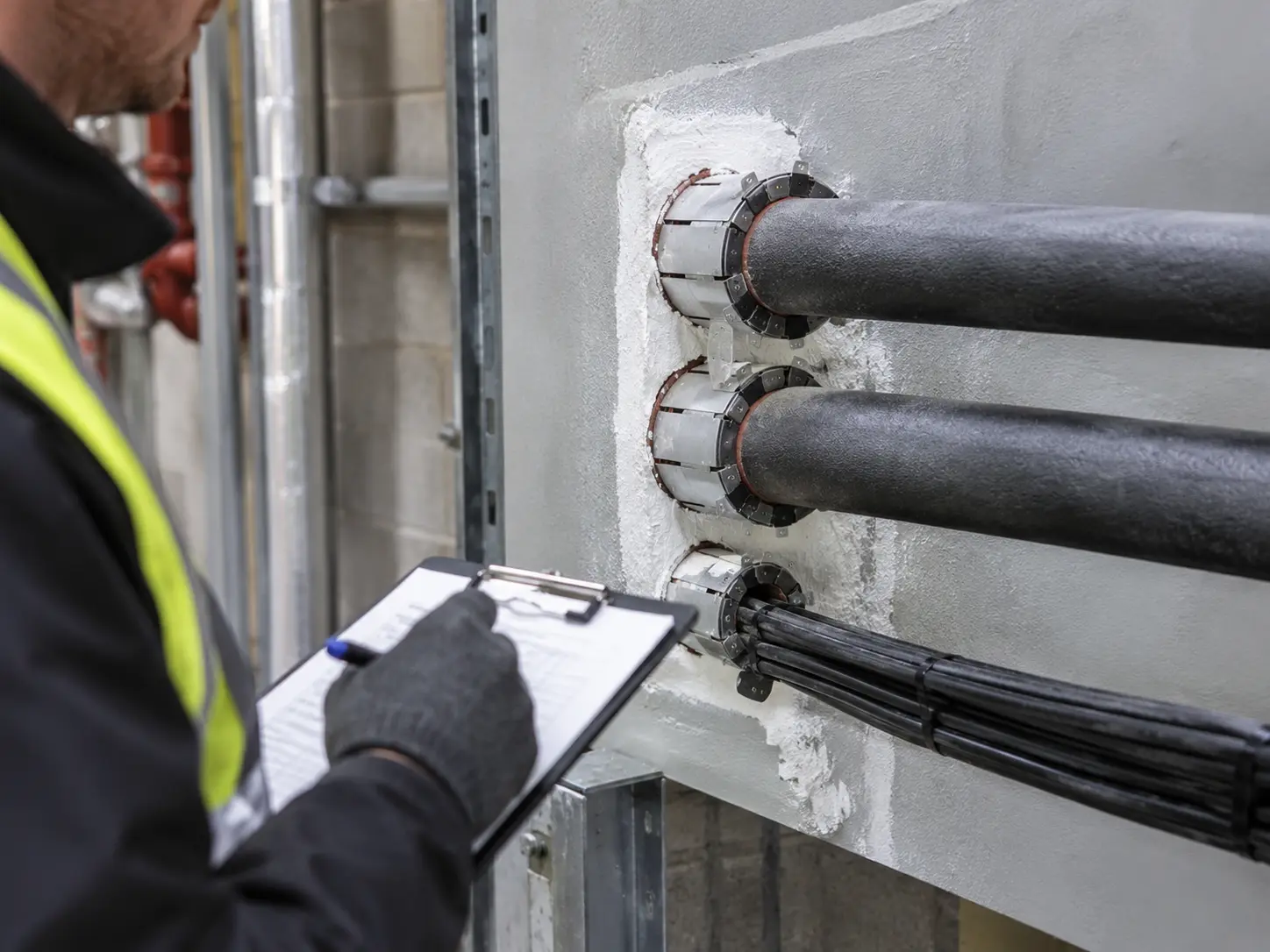
Fire stopping around a service penetration
HOW THOROUGH DOES IT NEED TO BE?
How far a survey goes depends on what you need to know, and what access is realistically available.
Not sure which level you need?
Tell us about your building and we will advise.
HOW THIS RELATES TO FIRE DOORS
Fire doors and compartmentation are two parts of the same system. A door can be perfectly specified, fitted and maintained, and still fail to do its job if the wall around it has unsealed gaps, damaged fire stopping, or a compromised void above the ceiling.
Because of this, we often recommend a passive fire protection survey alongside our fire door work, so the whole compartment line is checked together rather than the door being assessed in isolation from the wall it sits in.
See our Fire Door Inspections service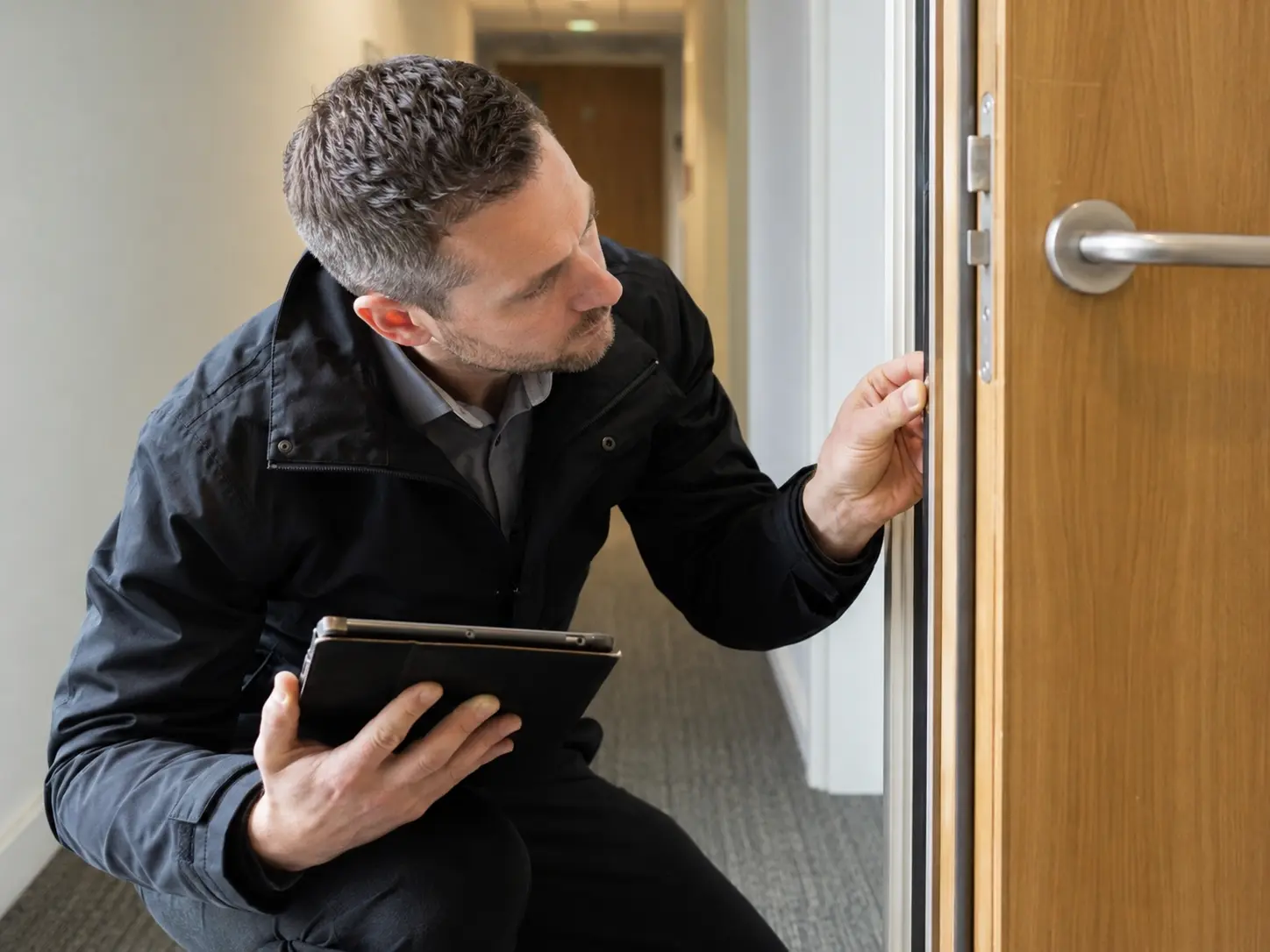
Fire door within a compartment wall
Who it applies to
If your building is divided into fire resisting compartments, which almost all non-domestic and multi-occupied residential buildings are, it is worth knowing whether that protection is intact. This matters most where a building has had cabling, plumbing or other services installed or altered over time, since that is when compartment lines are most often unknowingly compromised.
Not sure what your building needs?
Tell us a little about the premises and we’ll help you understand the right next step.
WHO IS RESPONSIBLE
This is the Responsible Person, whether that is an employer, a building owner, a landlord or a managing agent. For RTM companies and residents' management companies, this often falls to volunteer directors who have inherited a building without a clear picture of what is behind the walls, which is a common and understandable starting point.
Bringing us in does not transfer that legal responsibility. We give you clear findings and a prioritised way forward, but acting on them remains with you as the Responsible Person.
Check who's responsible on your siteTHE BIGGER PICTURE
Fire stopping is not an isolated job done at the end of a project. It is one of the ways your building's fire strategy is actually delivered on site. A fire strategy sets out how long each compartment is designed to hold back fire, based on the building's layout, use and escape routes. Fire stopping is what makes sure the physical building matches that design, sealing every point where the compartment line could otherwise be breached.
This is why the same defect can mean different things in different buildings. An unsealed penetration matters more where the fire strategy is relying on that wall to protect the main escape route, and less where it separates two lower-risk storage areas. Understanding your fire strategy is what lets us explain not just what we found, but why it matters for your specific building.
If you do not currently have a fire strategy, or are not sure whether the one you have is up to date, our Fire Strategies service can help establish that wider picture alongside your survey.
Ask about your fire strategySCOPE OF WORK
Exactly what we cover depends on the survey level agreed, but a thorough check typically includes the following.
Compartment walls
Condition and continuity of fire resisting walls
Compartment floors
Condition and continuity between floors
Service penetrations
Pipes, cables and ducts passing through fire resisting elements
Risers and shafts
Vertical service routes between floors
Voids above suspended ceilings
Whether compartmentation continues through the void
Wall and floor junctions
Where different elements meet
Fire stopping materials
Whether the right materials have been used correctly
Fire doors within the line
Consistency with the surrounding compartmentation
The process
We keep the process clear and practical, from agreeing the right survey scope through to a prioritised report and support with what happens next.
01
We agree the right survey level and scope for your building.
02
We look at any plans, previous surveys or fire strategy documents.
03
We examine the compartment lines in the agreed scope in person.
04
We weigh up what we found against what is required.
05
Findings written up clearly, prioritised against your fire strategy.
06
We talk you through the report and what to do next.
Ready to get started?
Get a quote in a couple of minutes, no obligation.
The deliverable
At the end of the process, you will get a clearly structured written report that includes:
A compartment-by-compartment asset register
Deficiencies we have identified
Photographs of each area examined
A prioritised action plan
Findings against the relevant standard
Practical, proportionate recommendations
Areas that are already satisfactory
Information on when to review or re-check
This becomes a live reference you can build on over time, rather than a one-off document that goes out of date the moment something changes.
See what's included
Passive fire protection survey
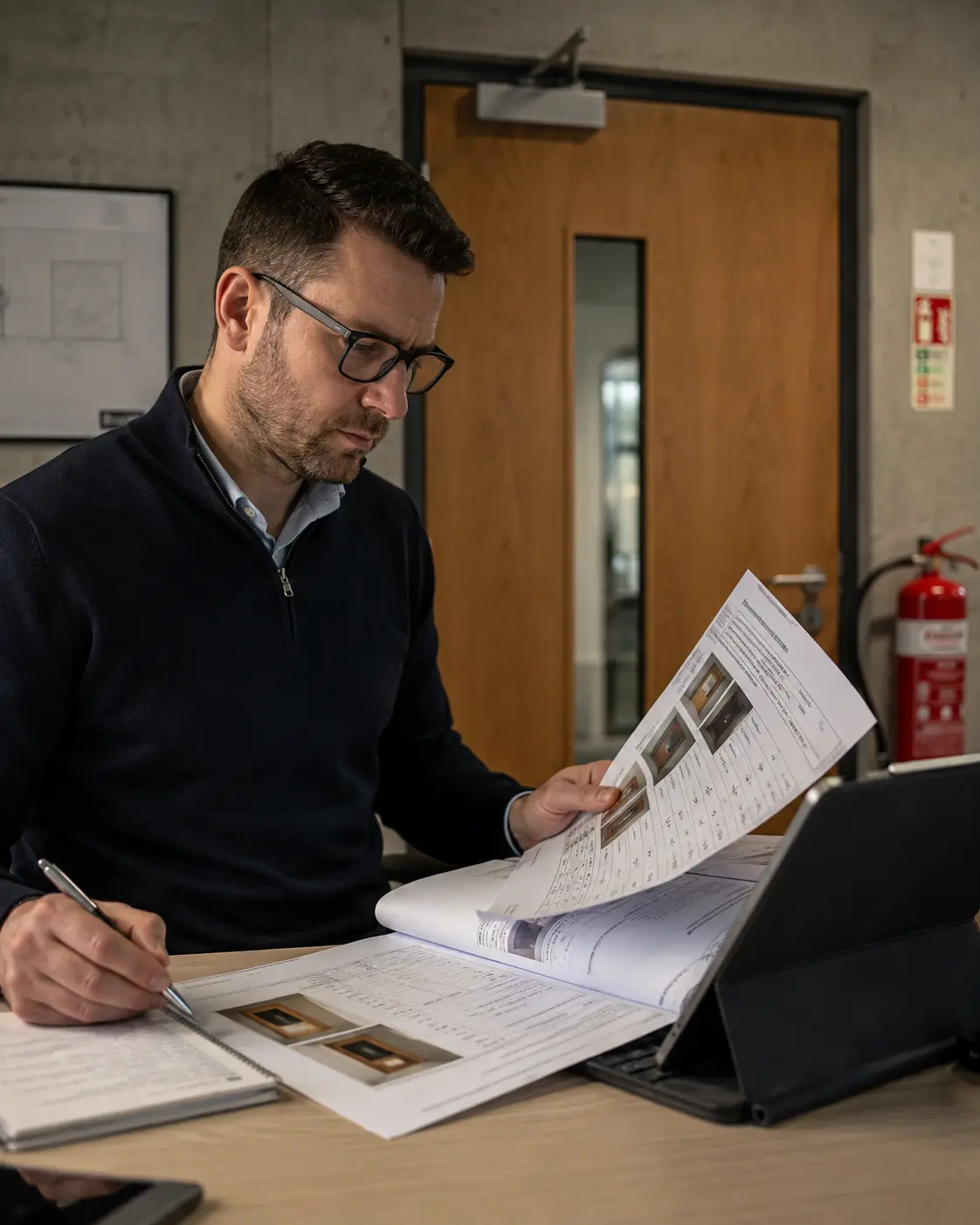
Example layout showing the type of structured information a client receives.
Reviewing an existing third-party survey
INDEPENDENT REVIEW
We are often asked to review a compartmentation or passive fire protection survey that someone else produced, whether to check it is thorough and accurate, or to make sense of a report that raised more questions than it answered.
Because we do not carry out remedial fire stopping works ourselves, our review is genuinely independent. We are not incentivised to find extra work, and we will tell you plainly if an existing survey is sound rather than second-guessing it for the sake of it.
Get a Survey ReviewedWHAT TO LOOK OUT FOR
These are some of the issues we see most often. Almost none of them are visible without a proper check.
COMMON
A pipe, cable or duct passing through a wall without proper fire stopping leaves a direct route for fire and smoke.
COMMON
Fire stopping that has degraded, been removed, or was never installed correctly cannot do its job.
SERIOUS
Holes cut for access, storage or alterations can compromise an entire wall's fire resistance.
COMMON
General-purpose sealant or foam is not the same as tested, rated fire stopping material.
COMMON
Where a compartment wall meets the floor or structure above, an unsealed gap can undo the whole line.
SERIOUS
Compartment walls that stop at ceiling height, rather than continuing to the structure above, leave the void unprotected.
Spotted something that looks like this?
Get it checked properly rather than guessing.

Founder & Principal Consultant
ABOUT ESI
We are a small, specialist, consultancy led team, overseen by Jamie Morgan, who is listed on the Institute of Fire Safety Managers National Fire Risk Assessors Register and holds Level 4 and Level 6 qualifications in fire risk assessment.
We do not carry out remedial fire stopping or compartmentation works ourselves. That keeps our findings independent: we have no reason to find more work than is actually needed, and every recommendation is about what your building genuinely requires.
We also look at compartmentation as part of the wider building, not in isolation, drawing on the same expertise we bring to fire risk assessments, fire strategies and fire door work.
"Independent survey, assessment and reporting. No remedial fire stopping sales."
NFRAR
Registered fire risk assessor.
Qualifications
Level 4 and Level 6 fire risk assessment qualifications.
IFSM
Professional membership and ongoing industry engagement.
URGENT COMPARTMENTATION SUPPORT
These need a fast response. Call our team now for urgent help understanding what's required and getting it resolved.
Common questions
Get started
To put together an accurate quote, it helps if you can let us know a bit about your building. Do not worry if you are not sure exactly what you need, we would rather have a conversation and work it out together.
Tell us what you know. If you cannot answer everything, we would rather have a conversation and work it out together.
Tell us a little about the premises and what has prompted the enquiry.